Why every hotel-chain AI initiative in 2026 is bottlenecked at the same layer — and what to do about it.
In February 2026, Marriott told the market it would invest more than a billion dollars in technology this year, with more than a third of that capital going directly into digital transformation. The announcement named the work plainly: replatforming the property management system, rebuilding the central reservations infrastructure, modernising the loyalty platform, and constructing what Marriott calls an "agentic mesh" — a shared intelligence layer designed to let AI agents operate consistently across brands, geographies, and channels. Hilton, in the same window, launched its AI Planner, a conversational concierge in beta on hilton.com. Hyatt embedded a ChatGPT app and added intent-based search on Hyatt.com. Accor put its loyalty app directly inside ChatGPT in more than twenty languages. IHG announced an AI-enhanced CRM and a programme to restructure hotel content into machine-readable formats so AI agents can reason over it. Within roughly six months, every major lodging brand had committed publicly to an agentic-AI roadmap.
What none of those announcements quite said is that every one of them is constrained by the same architectural problem. The brand-level vision — conversational search, AI personalisation, agentic concierge, dynamic offer activation — depends on a unified, real-time, governed view of the guest. That view does not exist in any major hotel group today. It is fragmented across the property management system, the central reservations system, the revenue management system, the loyalty platform, the marketing CRM, the F&B point of sale, the spa system, the mobile app, the channel manager, and several other places. The PMS is the single largest holder of guest signal, but it is not the only one, and crucially it is not authoritative for the entity. Until that changes, the agentic-AI roadmap will run faster on slides than on production.
This piece is about why the hotel industry's AI problem lives in the PMS — and equally, why it does not.
What the PMS was built to do, and why that matters now
The property management system is the operational nerve centre of an individual hotel. It manages reservations and the room block, handles check-in and check-out, sits at the heart of the night audit, and integrates downstream with everything from housekeeping schedules to F&B billing to telephone systems. It was designed in the era when a hotel was a property, and a guest was a stay. The data model reflects that origin. The primary key is the reservation. The guest is an attribute of the reservation. When the guest returns six months later under a slightly different name spelling, they are usually a new attribute of a new reservation, and the system has no native concept of identity continuity beyond a loosely matched profile record that exists at the property level and is rarely reconciled across the chain.
That design was correct for an industry whose unit of work was a stay at a property. It is the wrong design for an industry whose unit of work is increasingly a relationship with a guest across brands, properties, channels, and decades. AI is not the cause of this mismatch; AI just makes the mismatch impossible to ignore. A conversational concierge that cannot remember what the same guest told a different brand's concierge two trips ago is not a conversational concierge. It is a search box with better grammar. The replatforming wave the industry is now in — Marriott to Oracle Opera Cloud, Motel One completing a hundred-plus property migration to the same platform, Hilton breaking from Opera entirely in favour of HotelKey, PPHE and Rotana standardising on Opera Cloud across their estates — is real and necessary. It is also not, on its own, the answer to the AI question.
The PMS market itself reflects the strategic stakes. Different research houses size the market differently depending on how broadly they define it — narrow-scope estimates put the hotel PMS software market around US$1.7 billion in 2026, while broader scopes that include adjacent operational software push the figure above US$8 billion — but every reading shows the same shape. The top five vendors hold about sixty percent of the market. Cloud deployment is growing at roughly a twelve percent compound annual rate. New entrants are concentrating in specific niches such as boutique chains, vacation rentals, and full-service luxury, leaving the volume battle to a small handful of platforms.
For brand CIOs, this means the PMS layer is consolidating onto a small number of cloud-native platforms whose roadmaps are increasingly AI-aware. That is good news. The bad news is that the consolidation is happening platform by platform, property by property, while the AI use cases the C-suite has signed off on require something the PMS, no matter how cloud-native, was never asked to deliver: a single, trustworthy, real-time entity layer for the guest, sitting above all properties and all brands.
Where guest data actually lives
The defining feature of the hotel data estate, viewed honestly, is that no single system holds the guest. The PMS holds the largest single share of guest signal — the stay record, the room preference, the loyalty number captured at check-in, the special-request memo — but that share is rarely more than a fifth of what the chain knows about the guest in aggregate. The central reservations system holds the booking funnel, the rate strategy decisions, and the corporate-account context. The revenue management system holds the segment-level pricing logic that shaped what offer the guest saw. The loyalty platform holds the membership history, the points balance, the tier movement, and the cross-property stay record. The CRM and marketing automation tools hold the campaigns, the responses, the channel preferences. The F&B point of sale holds the dining behaviour. The spa system holds the wellness behaviour. The mobile app holds the digital-key activity and increasingly the in-stay messaging. The channel manager holds the OTA-originated bookings, often with masked email addresses that do not match anything else in the estate. The reviews and social listening platforms hold the post-stay sentiment. The concierge messaging platform holds the requests the guest made in their own words.
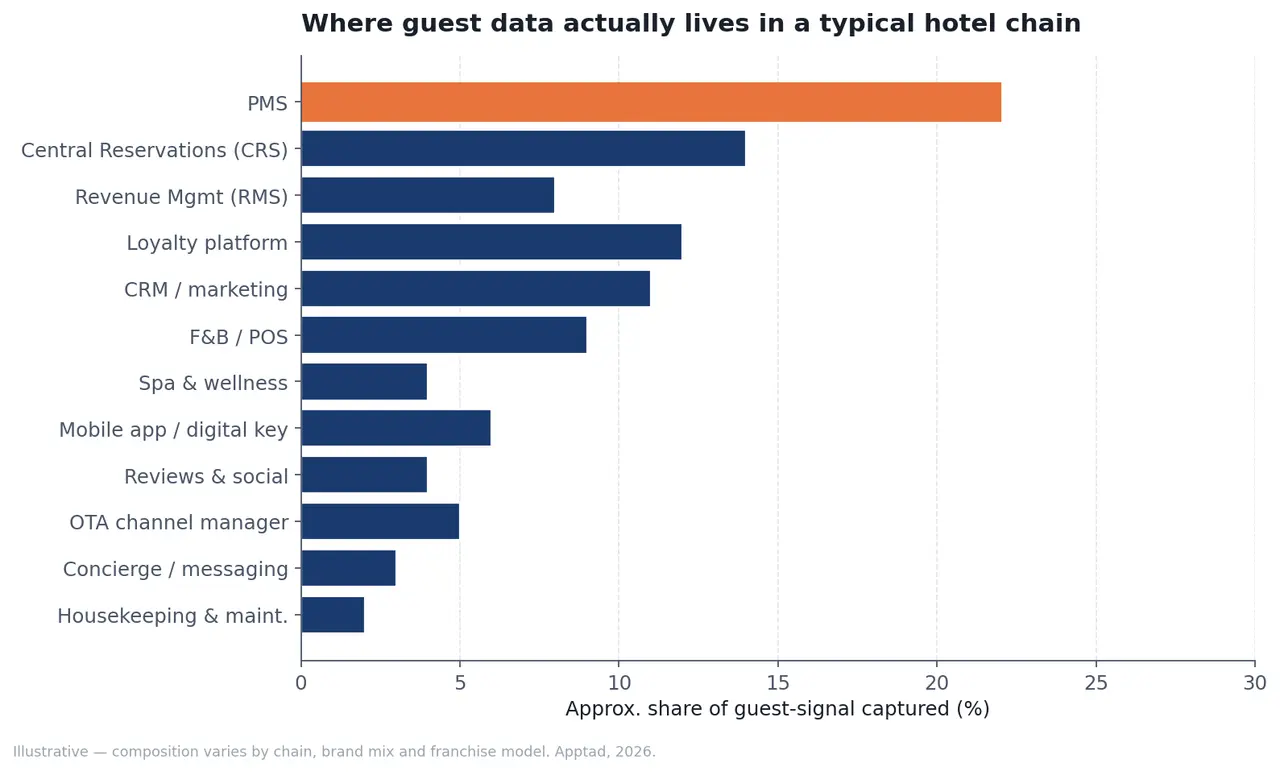
The chart above is a directional view of how guest signal is distributed across the typical chain, with the PMS shown as the single largest holder of that signal — and yet not even a quarter of it. The composition varies by chain, brand mix, and franchise model; full-service luxury and boutique brands typically have a smaller PMS share because spa, F&B, and concierge systems carry more of the signal, while limited-service brands often have a larger PMS share because there are fewer ancillary systems generating data. The point of the chart is not the exact percentages. The point is that the PMS, despite being the single most important operational system in the hotel, is not large enough to serve as the entity layer for any AI use case that depends on the chain knowing who the guest is across every touchpoint.
This is the architectural reality every hotel-chain AI initiative now collides with. The personalised offer, the conversational concierge, the dynamic upsell at check-in, the loyalty journey orchestration — each one of them needs a guest profile assembled in real time from a dozen sources. Each one of them will fail if the assembly is brittle, if it lags, if it duplicates, or if it loses the source-system context that makes the profile defensible to a compliance officer.
The integration reality
The honest assessment of where the industry actually is on assembling that profile is uncomfortable. Synthesised across recent industry studies and platform vendor surveys, the picture looks roughly like the chart below: fewer than one in four hotels report that their core systems — PMS, CRS, RMS, loyalty, CRM — are fully integrated in a way that supports a unified guest profile. Roughly half are partially integrated, typically meaning two or three of the systems exchange data on a scheduled basis. Roughly three in ten are largely siloed, with reconciliation happening manually or not at all.
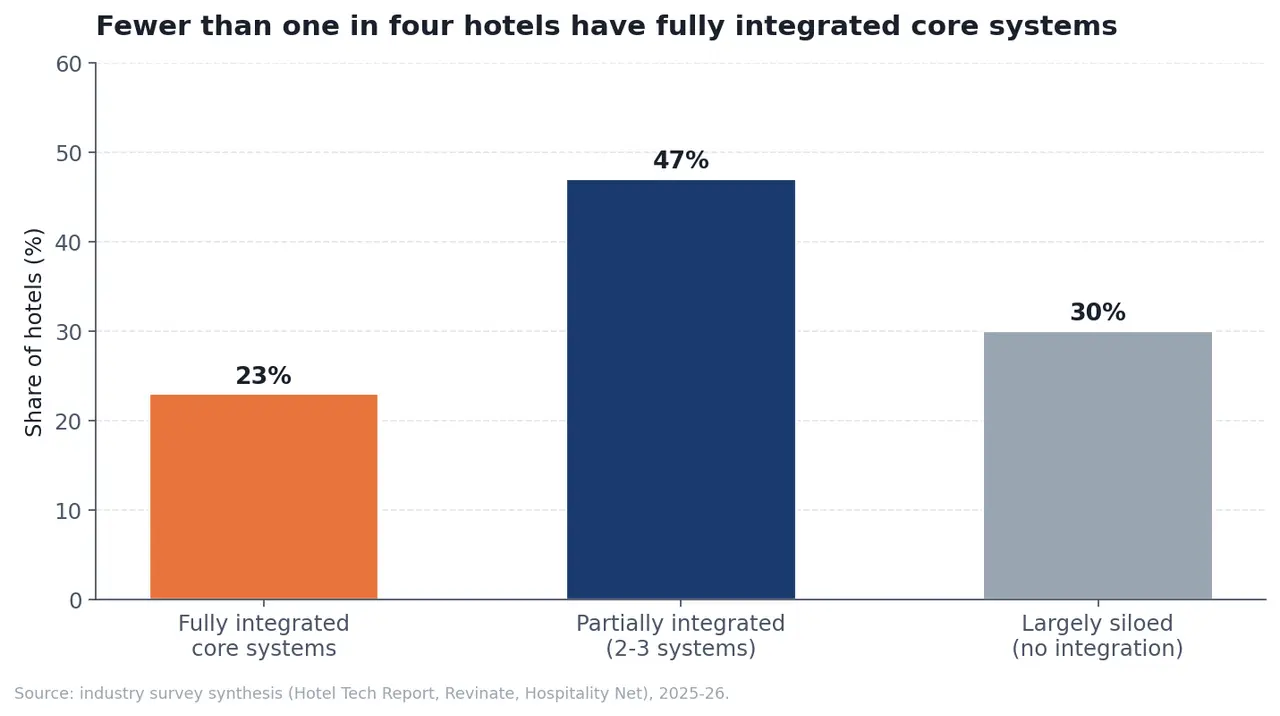
That distribution is the gap between the AI announcement and the AI delivery. A brand can commission an agentic concierge in the boardroom and discover, in the second sprint, that the system cannot reliably identify the same guest across the PMS, the loyalty platform, and the mobile app. The team will spend the next six months on what looks, from the outside, like AI development. It is almost entirely data integration and identity resolution. The model is rarely the bottleneck. The data foundation is.
The brand-versus-property divide
There is a structural complication beneath the fragmentation problem that deserves naming, because it sits underneath every other issue and is rarely surfaced in technology conversations. Most major hotel brands do not own the properties that fly their flag. The relationship is governed by a franchise or management agreement that runs for decades. The brand owns the loyalty programme, the central reservations system, the brand standards, and the marketing — but the property owner, or the management company running the property, owns the physical operation, the staff, and, in many agreements, has a contested claim on the guest data captured at the property.
The legal and commercial position varies by chain, by region, and by individual contract. Some brands require properties to push all guest data into the brand's central platforms in real time. Some allow the property to retain a local copy. Some have data-sharing clauses that are clear on paper and unclear in practice. The result, across the industry, is that the guest data captured at a property does not always flow cleanly back to the brand, the guest data held by the brand does not always flow cleanly down to the property, and when a franchise relationship ends, the parties frequently end up litigating over who owns what.
This is not a side issue. For an AI roadmap that promises a unified guest experience across the brand portfolio, the data-rights question is foundational. The agentic concierge cannot lean on data the brand does not legally have permission to use. The personalised offer cannot reference a guest history the brand cannot prove it owns. The compliance review that protects the AI use case from a regulator's challenge depends on a clean chain of consent and ownership from the moment the data was captured to the moment the model used it. In a franchise-heavy estate, that chain is often the most fragile part of the entire system.
The teams that are pulling ahead on this are the ones that have started rewriting their franchise and management templates around data — defining ownership and usage rights explicitly, building shared data-product layers that both brand and property can consume, and treating the data architecture as a commercial conversation rather than only a technical one. The teams that are falling behind are the ones treating it as an IT problem and discovering, in year two of their AI programme, that the IT problem is actually a contracts problem.
The duplicate-profile problem
Even within the boundary of what a brand legally controls, the data is messier than its dashboards suggest. Identity-resolution platforms that work with hotel chains report a typical duplicate-profile rate of around six percent of total profile count, with some estates running as high as sixteen percent. Most of the duplication originates at check-in: placeholder email addresses entered when a guest declines to give one, combined name fields that confuse downstream matching, missing or malformed phone numbers, masked addresses pushed through by OTA bookings, transliteration variants in international markets. These are not unusual issues. They are baseline hotel operations.
The implications for AI are direct. Every AI use case the brand has signed up to ship — personalised recommendations, segment-level dynamic pricing, loyalty offer activation, agentic concierge — is sitting on top of a profile estate where between six and sixteen percent of the profiles are duplicates that should be merged. The chart below makes the relationship visible.
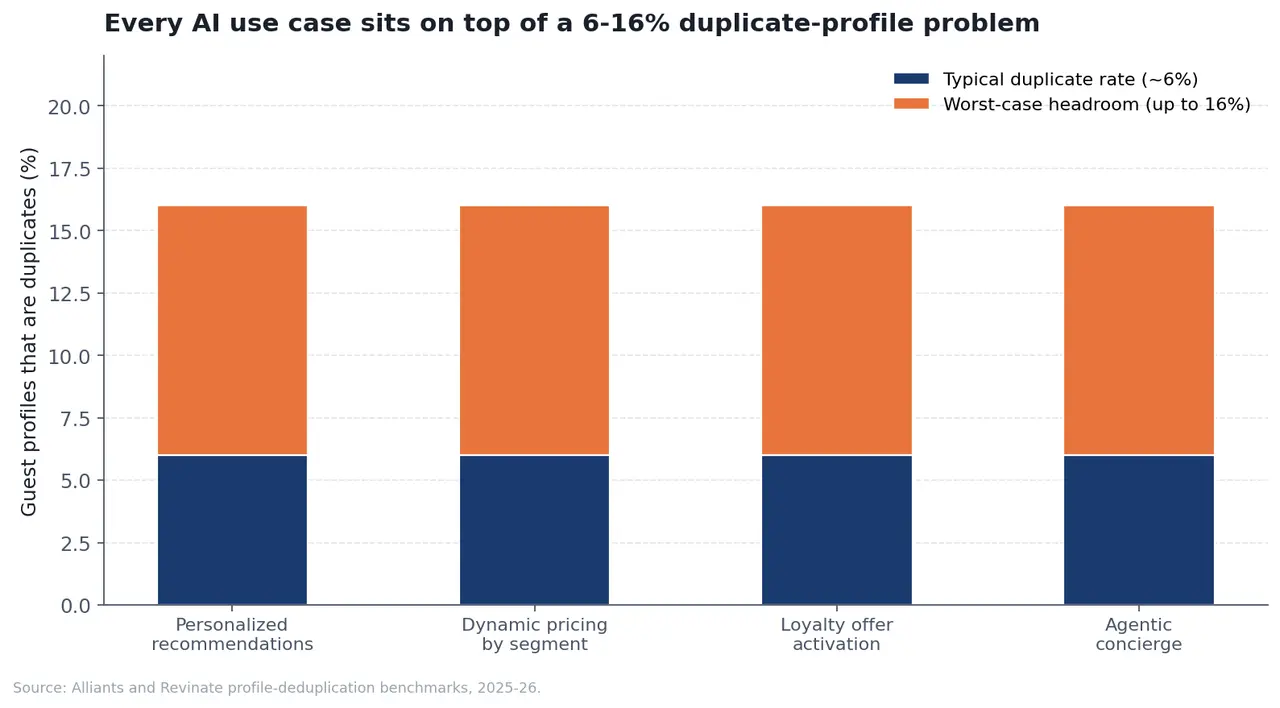
In aggregate terms, a chain with two hundred million guest profiles and an eight percent duplicate rate is reasoning over sixteen million ghost guests. The model does not know they are ghosts. The model treats them as discrete entities, splits the signal across them, and produces recommendations that are weaker than they should be, segmentation that is finer than it should be, and offers that target the same physical guest more than once. None of these failures are visible in a model evaluation. They are visible only in the disappointing results of the AI use case, six months after launch, when somebody senior asks why the personalisation engine is not moving the needle on conversion the way the business case said it would.
This is the single most consequential operational gap between the AI vision and the production reality. It is also the most fixable. Identity resolution at the hospitality scale is a mature discipline, with established techniques across fuzzy matching, loyalty-ID anchoring, probabilistic linkage, and supervised review for the most ambiguous cases. The work is unglamorous. The work is also the precondition for every AI claim the brand wants to make.
What replatforming alone cannot fix
The PMS replatforming wave is real and it is necessary. Cloud-native PMS platforms — Opera Cloud, HotelKey, Mews, Stayntouch, Cloudbeds, Apaleo, and their peers — give brands what the on-premise generation could not: open APIs, faster release cycles, native integrations with the surrounding ecosystem, and significantly lower IT overhead at the property. Marriott is not migrating to Opera Cloud because the technology was failing; it is migrating because the existing architecture cannot support the AI roadmap the company has already committed to.
But replatforming the PMS, on its own, will not deliver the AI use cases the C-suite has signed off on. It removes a constraint. It does not provide the answer. The answer is an entity layer — a trusted, governed, real-time master data foundation for the guest — that sits above the PMS, above the CRS, above the loyalty platform, and above the marketing CDP, and that all of those systems consume from rather than each maintaining their own version. The leading brands have already recognised this. Marriott's "agentic mesh" is exactly this layer, named in a way that emphasises its function for AI rather than its function for data management. The naming matters. It signals that the brand is no longer treating the data foundation as an IT housekeeping project. It is treating it as the productive substrate on which the next decade of revenue will be built.
For brands that have not yet committed at that level, the question is not whether to build this layer but how to build it without disrupting the in-flight PMS migration, without re-litigating the franchise data-rights conversation from scratch, and without falling into the trap of buying a CDP and assuming the CDP is the answer. A CDP is one of several tools that sit inside the entity layer. It is not the layer itself. The layer is a discipline — master data management for guest, property, rate plan, loyalty member, employee, and supplier entities — that the brand decides to operate consistently across the estate. The tools come second.
A 90-day diagnostic for hotel CIOs
For a hotel-chain CIO trying to convert an AI roadmap into a deliverable plan, the first ninety days are best spent not building AI but mapping the data foundation underneath it.
The first thirty days are an entity audit. For each of the top ten AI use cases on the roadmap, document the guest, property, and rate-plan entities the use case reasons over, the systems each entity is sourced from, the freshness requirements, and the consent and ownership chain from the source system to the model. Most teams have never done this exercise honestly. When they do, the gaps are usually large and consistent across use cases, which means the remediation is leveraged: fixing the guest entity once benefits every AI use case at the same time.
The second thirty days are a fragmentation honest-look. Inventory every system that holds guest signal, including the ones nobody on the AI team initially mentions — the spa booking system, the loyalty partner data feeds, the concierge messaging platform, the in-room entertainment provider's data exchange, the local F&B reservation system at the flagship property. For each, document the integration state, the duplicate rate as best as can be estimated, and the data-rights position under the relevant franchise or management agreement.
The third thirty days are a target-state design. Choose a master data management posture — typically a registry plus consolidation pattern for guest, supported by Reltio, Informatica, or STIBO, depending on what the brand already has in the estate. Define the data products the brand will serve to AI use case teams: a real-time guest entity, a near-real-time stay history, a property and rate-plan reference, a consent and preferences record. Set the operating model: who owns the data product, who owns the use case, how franchise properties consume it, how the brand's central CDP and CRM consume it. The output of the quarter is not a built system. It is a plan that, for the first time, takes the AI roadmap and the data foundation seriously as the same project rather than two parallel ones.
The reframing
The hotel industry's AI moment is genuinely here. The brand-level vision is correct. The use cases are real, the technology is available, and the consumer appetite has been confirmed every quarter for the last two years. The constraint is not vision and it is not budget. The constraint is the architectural decision, made forty years ago and rarely revisited, that the property management system was the centre of the data universe and everything else would be an integration to it. That decision served the industry well in the era when a guest was a stay at a property. It is the wrong centre of gravity for the era when a guest is a relationship across the chain, and the AI use cases the industry has now committed to depend on getting the new centre of gravity right.
The PMS still matters enormously. It is still the operational backbone, still the largest single holder of guest signal, still the system the property staff live in every day. But it is not the entity layer for the brand, it never was, and the brands that recognise that first will pull ahead of the brands that are still treating their PMS migration as the AI roadmap.
Apptad partners with hotel-chain CIOs, CDOs, and digital-transformation leaders to design and stand up the entity layer that makes hotel AI work — master data for guest, property, rate plan, loyalty member, and supplier; real-time integration with Opera Cloud, HotelKey, Mews, Stayntouch, Salesforce, Reltio, Informatica, STIBO, and the surrounding hospitality ecosystem; and the franchise and management-contract data-rights conversation that has to happen alongside the technology. If your AI roadmap is moving faster than your data foundation can support, the bottleneck is not the model. It is the layer underneath. That is the conversation worth having.