On paper, moving off Informatica PowerCenter is one of the cleaner modernization stories an enterprise can tell. Retire the aging on-premises server, lift your data integration into the Intelligent Data Management Cloud (IDMC), and walk away with lower infrastructure cost, elastic scale, and a platform that is still being invested in. The vendor deck says six months and a contained budget. The steering committee approves it.
Then the project lands somewhere very different — eleven months in, the better part of half a million dollars spent, and a team explaining to a CFO why "just move the mappings" became a line item nobody recognizes. The uncomfortable truth is that these overruns are rarely bad luck. They follow a pattern, and because the pattern is predictable, it is also avoidable. This piece walks through what a six-figure overrun actually looks like, where the money goes, and the safeguards that keep a migration on its original number.
A composite that will look familiar
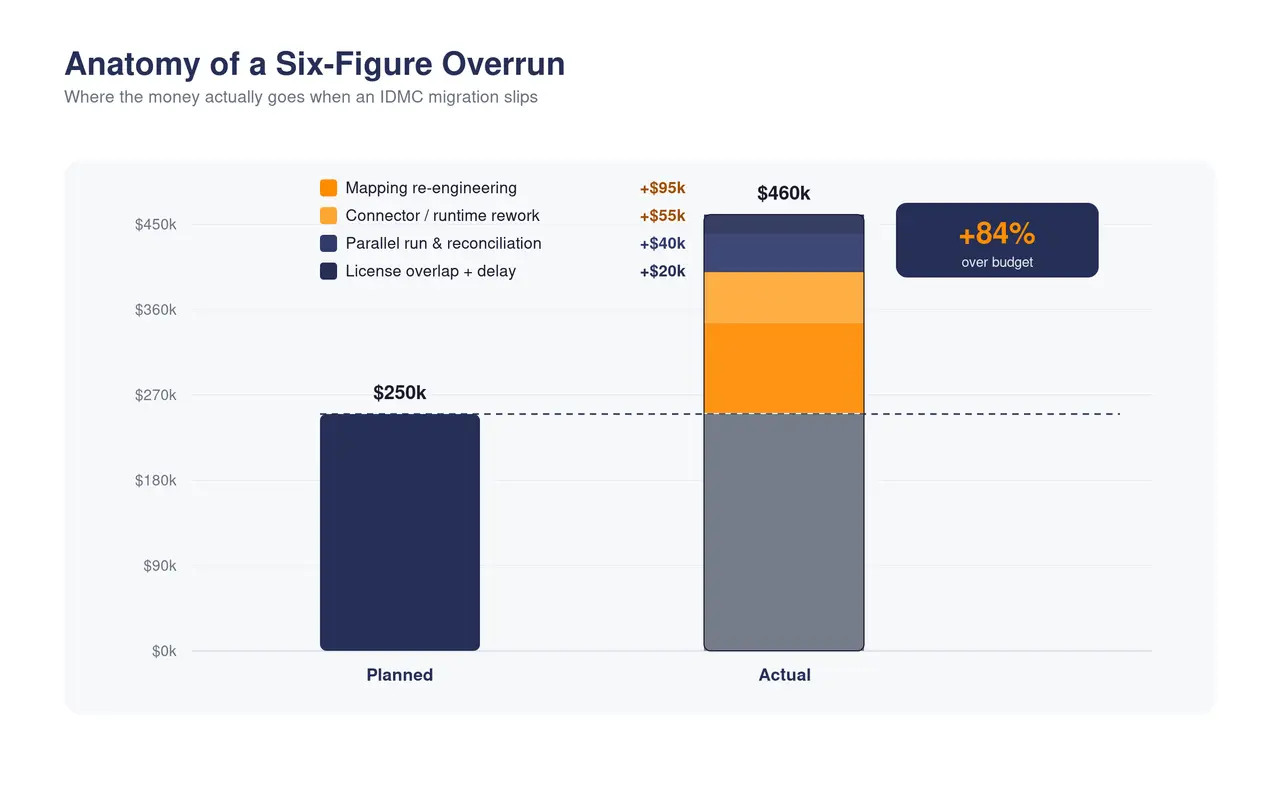
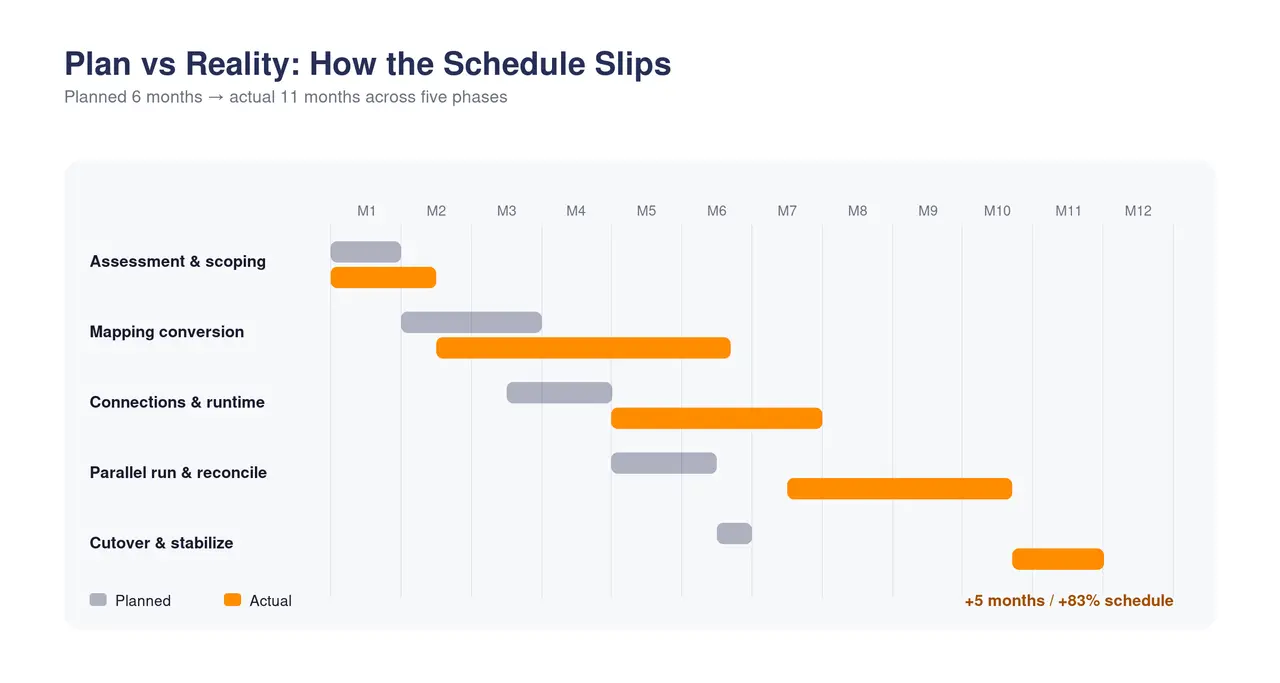
Consider a mid-sized migration scoped at $250,000 over six months: a few hundred PowerCenter mappings, a dozen source and target systems, and a "like-for-like" re-platform onto IDMC's Cloud Data Integration (CDI). Nothing exotic. By the time it closed, the same project had spent roughly $460,000 and run eleven months — an 84% cost overrun and nearly double the timeline.
The schedule tells the same story phase by phase. Every stage that touched real data logic — conversion, runtime setup, reconciliation — expanded well beyond its plan, and because the phases are sequential, each slip pushed everything behind it.
Where the money actually goes
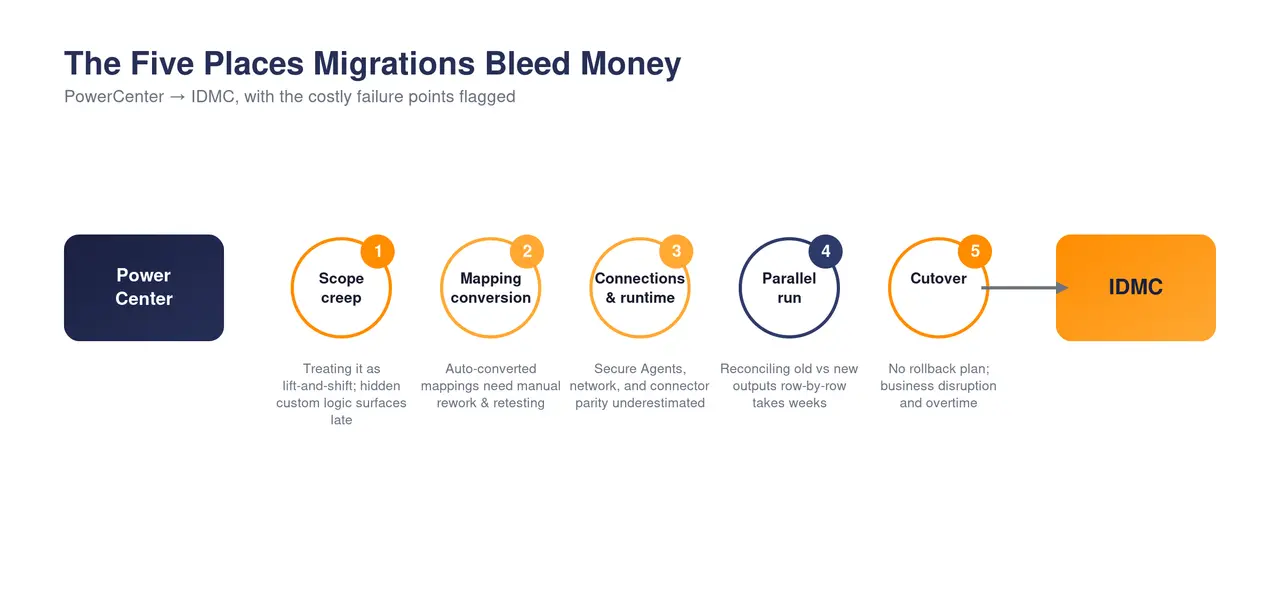
Overruns do not come from the platform being expensive. IDMC subscription cost is usually the most predictable part of the whole program. The money disappears in five specific places — and they are the same five places on most engagements.
1. The lift-and-shift assumption
The single most expensive decision is made before the project starts: budgeting a migration as if it were a copy-and-paste. PowerCenter repositories accumulate a decade of undocumented custom logic — reusable mapplets, parameter files, pre- and post-session commands, shell scripts wired into workflows. None of that surfaces in a quick repository count. When it appears mid-project, scope expands against a budget that assumed it was not there.
2. Mapping conversion that is not automatic
Informatica's conversion utilities genuinely help, but "converted" is not "done." Auto-translated mappings frequently need manual rework where a PowerCenter transformation has no clean CDI equivalent, and every one of them has to be re-tested against expected output. Teams routinely find that the tooling gets them 60–70% of the way, and the remaining tail consumes far more effort per mapping than the easy majority.
3. Connections and runtime, underestimated
IDMC runs integration through Secure Agents that have to be installed, sized, and granted network paths to every source and target. Firewall rules, private-link connectivity, driver parity, and credential vaulting are quietly assumed to "just work." They rarely do on the first pass, and connectivity issues block testing — which means idle, paid consultants waiting on infrastructure tickets.
4. Parallel run and reconciliation
Before anyone trusts the new platform, old and new have to run side by side and produce the same numbers. Reconciling outputs row by row — chasing down every rounding difference, null-handling change, and sort-order quirk — is slow, detailed work that almost always takes longer than planned. It is also non-negotiable: skip it and you trade a schedule risk for a data-integrity incident.
5. Cutover without a rollback
The final trap is a big-bang cutover with no tested way back. When something breaks during the switch — and something usually does — a team without a rollback path improvises under pressure, burns overtime, and disrupts the business it was meant to protect. The cost shows up twice: in consulting hours and in lost productivity downstream.
The pattern behind the burn
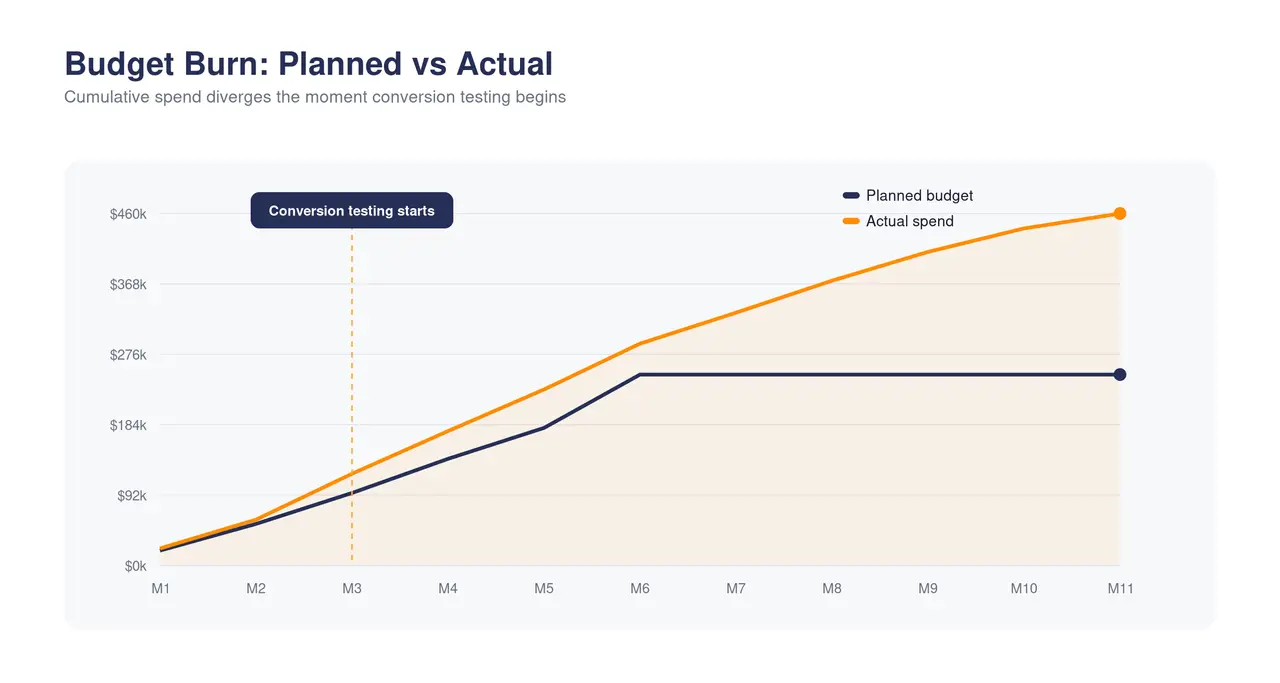
Plotted over time, the two budgets track closely for the first few weeks and then split — and they split at a consistent moment: when conversion testing begins and the hidden complexity becomes visible. Up to that point the project feels on track, which is exactly why overruns are so often caught late, when the options for correcting course are most expensive.
How to avoid a six-figure overrun
None of these failure points require heroics to prevent. They require front-loading the work that teams typically defer. Five safeguards address the five drivers directly.
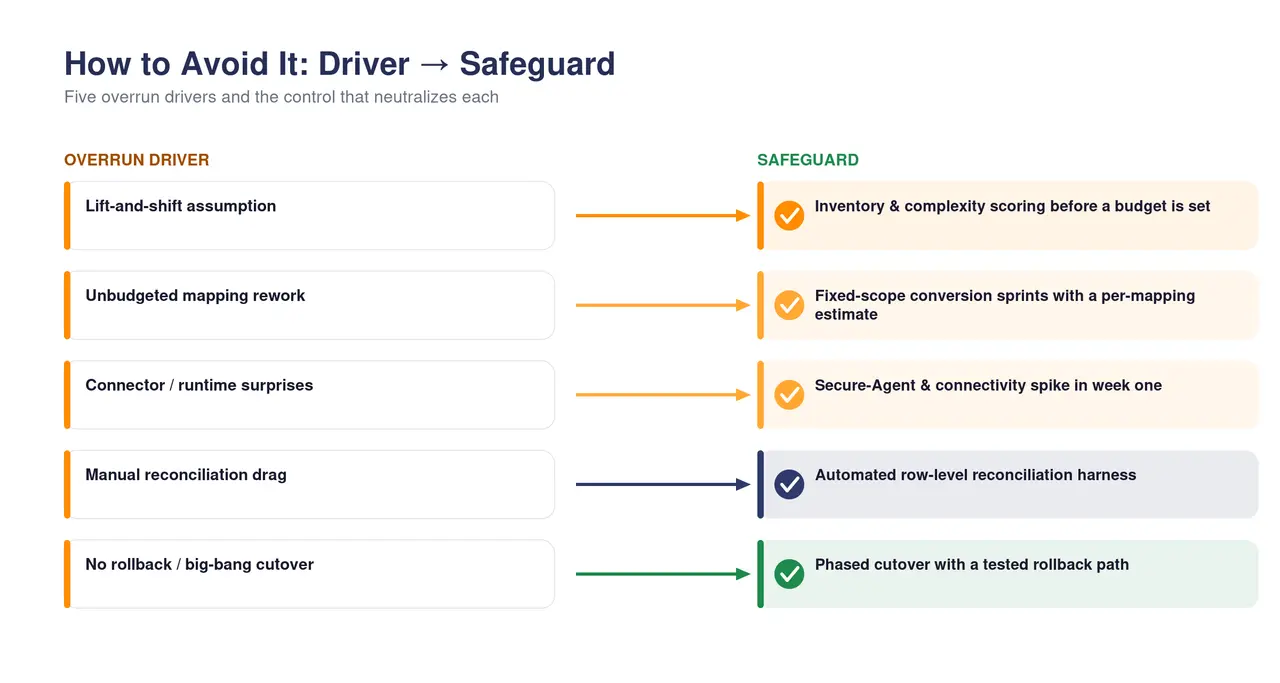
Start with a complexity-scored inventory, not a mapping count. Before a budget is committed, catalog every mapping, mapplet, parameter file, and external script, and score each for conversion difficulty. The number you carry into the steering committee should reflect the hard 30%, not the easy majority.
From there, treat conversion as fixed-scope sprints with a per-mapping estimate, so rework is planned capacity rather than a surprise. Spike Secure Agent installation and connectivity in week one, while there is still schedule to absorb the inevitable firewall and driver issues. Build an automated, row-level reconciliation harness instead of eyeballing samples — it pays for itself the first time it catches a discrepancy. And phase the cutover with a tested rollback path, so the switch is reversible and the business never depends on everything going right at once.
The takeaway
A six-figure IDMC overrun is almost never a technology failure. IDMC is a capable platform, and PowerCenter migrations succeed every day. Overruns are a planning failure — the predictable result of budgeting for the migration you hope for instead of the one your repository actually contains. Scope the complexity honestly up front, and the same project that blows past $460,000 lands much closer to its original $250,000.
At Apptad, this is the work we do before a number is ever put in front of a CFO: inventory and complexity-score the existing estate, estimate conversion realistically, and design a phased cutover with reconciliation and rollback built in. If you are planning a move off PowerCenter and want the budget to survive contact with reality, that is the conversation worth having first.