Evaluating LLMs for Regulated Workflows: A Benchmarking Framework
Reading time: ~22 minutes | Audience: ML Engineers, Risk Officers, Compliance Teams | Domains: Finance · Healthcare · Legal · Insurance
Deploying a large language model into a regulated workflow is not the same as shipping a productivity chatbot. When outputs trigger financial decisions, inform clinical care, or constitute legal advice, the acceptable error rate approaches zero — and the consequences of failure are measured not in lost clicks, but in fines, litigation, and harm to real people.
Yet most LLM evaluation frameworks were designed for general-purpose capability: MMLU scores, HumanEval pass rates, and vibes-based red-teaming. These tell you almost nothing about whether a model will perform reliably inside a securities brokerage, a hospital EHR, or a compliance department. This post presents a structured benchmarking framework built specifically for regulated environments — one that you can adapt, score, and operationalize before a single line of production code is written.
Why Regulated Workflows Are Different
Regulated industries share a cluster of properties that make vanilla LLM evaluation insufficient. Understanding them is the prerequisite for designing any meaningful benchmark.
Consequence Asymmetry
In a general-purpose assistant, a wrong answer about the caloric content of avocado toast is a minor annoyance. In a clinical decision-support tool, a confabulated drug interaction can harm a patient. The asymmetry between false-positive and false-negative errors varies dramatically by domain, and your evaluation framework must model this asymmetry explicitly through weighted scoring — not treat all errors equally.
Institutional Accountability
Regulators expect organizations to be able to explain, reconstruct, and demonstrate the basis for decisions. This creates a hard requirement for auditability: not just accuracy in isolation, but the ability to trace how a model arrived at its output and whether that reasoning path is sound. Black-box accuracy numbers are insufficient.
Adversarial Inputs Are Not Edge Cases
Regulated workflows attract sophisticated adversaries. A fraud detection model faces deliberate attempts to evade classification. A contract analysis tool may encounter documents engineered to extract favorable interpretations. A KYC system will see identity manipulation attempts. Robustness under adversarial conditions must be a first-class evaluation concern, not an afterthought.
Critical insight: General-purpose benchmarks like MMLU, BIG-Bench, or HELM were designed to measure breadth of knowledge and reasoning — not the narrow, high-stakes reliability required in regulated contexts. A model that scores 90th percentile on MMLU may still be unacceptable for clinical or financial deployment. Domain-specific benchmark construction is non-negotiable.
Regulatory Traceability
FINRA, the FDA, the OCC, and analogous bodies increasingly require that AI systems used in decision-relevant workflows have documented testing and validation procedures. The benchmark framework itself becomes a compliance artifact — it must be defensible, reproducible, and version-controlled, not just a one-time internal exercise.
The 5-Pillar Benchmarking Framework
The framework proposed here organizes evaluation along five independent pillars. Each pillar is independently scoreable, and the framework supports both domain-agnostic baseline scoring and domain-specific weighting. All five pillars must be evaluated before any regulated deployment — skipping one is not a calibration choice, it is a risk acceptance decision that should be documented explicitly.
Pillar 01 — Factual Accuracy & Grounding Does the model produce outputs that are factually correct and grounded in cited, verifiable sources? Measured against curated domain knowledge bases and expert-annotated golden answer sets.
Pillar 02 — Hallucination Risk At what rate does the model generate plausible-sounding but false information? Measured via closed-book question probes, document-anchored QA divergence, and adversarial consistency testing.
Pillar 03 — Regulatory Alignment Does model behavior comply with applicable regulations, policies, and ethical constraints? Tested through scenario-based compliance probes and policy adherence suites.
Pillar 04 — Auditability & Traceability Can the model's reasoning be reconstructed, cited, and audited? Covers citation quality, chain-of-thought faithfulness, and log completeness requirements.
Pillar 05 — Robustness & Reliability Does model performance degrade gracefully under input perturbations, adversarial prompts, and distribution shift? Includes consistency, calibration, and stress testing.
"The goal is not to find the smartest model. It is to find the most reliably correct model at the specific tasks that matter — and to quantify the failure modes of every candidate before they encounter a real customer, patient, or regulator."
Pillar 01 — Factual Accuracy & Grounding
Factual accuracy in regulated domains is harder to measure than it sounds. The challenge is not simply asking trivia questions and checking answers — it requires evaluating whether the model's outputs are grounded in the specific regulatory state, policy version, or clinical evidence that applies at the time of the query.
Building a Golden Answer Set
The foundation of accuracy evaluation is a curated ground-truth dataset assembled by domain experts. This is expensive and time-consuming, and there is no shortcut. For financial compliance, this means question-answer pairs derived from current SEC releases, FINRA rulebooks, and applicable state regulations. For clinical use, it means SNOMED-CT coded responses validated against published clinical guidelines. The golden set must be:
- Temporally stamped (regulatory landscape changes; your golden set must reflect a specific version date)
- Annotated with difficulty tiers — routine, moderately complex, edge-case
- Expert-reviewed with at least two independent validators per answer
- Balanced across sub-domains to prevent evaluation gaming
- Segregated from any fine-tuning data to prevent contamination
Grounding vs. Memorization
An important and often overlooked distinction: a model may produce the correct answer by memorizing it from pre-training data rather than by grounding reasoning in provided context. In a regulated deployment, you typically provide the model with authoritative documents and expect it to reason from those documents. Grounding accuracy — does the model use the provided source correctly? — is often more important than closed-book accuracy.
Measure grounding accuracy by providing the relevant regulatory document alongside the question and evaluating both answer correctness and citation fidelity. A correct answer that cites the wrong provision, or cites a provision that does not actually support the answer, should score differently than one that is both correct and correctly attributed.
A practical scoring schema for each evaluation case might allocate 50% weight to answer correctness, 30% to whether the correct provision was cited at all, and 20% to whether the citation accurately matches the stated provision.
Pillar 02 — Hallucination Risk
Hallucination is the defining failure mode of LLMs in regulated contexts. Unlike inaccuracy from knowledge gaps — where a model simply doesn't know something — hallucination involves the generation of specific, confident-sounding, false content. A model that says "I don't know" when it should is safer than a model that generates a plausible but fabricated regulatory citation with apparent confidence.
Taxonomy of Hallucinations in Regulated Contexts
Not all hallucinations are equally dangerous. A practical taxonomy helps prioritize mitigation:
Citation Fabrication — Citing a non-existent rule or provision. Severity: critical. This is detectable but requires checking every citation against source documents.
Numerical Confabulation — Wrong threshold amounts, dates, percentages. Severity: critical. Relatively easy to detect via automated verification against structured data.
Entity Confusion — Attributing policy to the wrong regulator or jurisdiction. Severity: high. Harder to detect because the claim structure is plausible.
Temporal Drift — Applying superseded regulations as if they are current. Severity: high. Particularly dangerous in fast-moving regulatory environments like cryptocurrency or AI governance.
Extrapolation Beyond Evidence — Drawing conclusions not supportable by the provided documents. Severity: medium. Requires semantic evaluation to detect reliably.
Stylistic Confidence Inflation — Expressing hedged or uncertain knowledge with unwarranted certainty. Severity: medium. Dangerous because it suppresses human review of uncertain outputs.
Measuring Hallucination Rate
The most reliable approach combines three complementary methods. Closed-book probes ask questions where the correct answer is verifiable, without providing context documents, to surface base-rate confabulation. Document-anchored divergence testing provides documents and evaluates whether claims in the output are supportable from those documents. Consistency sampling asks the same question multiple times with temperature variation and measures variance — high inconsistency on factual questions signals unreliable knowledge representation.
Warning: Be cautious of models that hallucinate less on your benchmark than in production. Benchmark datasets often contain questions that partially overlap with training data. Construct evaluation probes from documents with recent dates and jurisdiction-specific details unlikely to appear in large pre-training corpora. Test with novel regulatory amendments from the past 12 months whenever possible.
Pillar 03 — Regulatory Alignment
Regulatory alignment asks: does the model behave in ways consistent with applicable laws, regulations, and organizational policies? This goes beyond factual accuracy to encompass behavioral compliance — what does the model do when faced with requests that are legally or ethically problematic?
Scenario-Based Compliance Probes
Compliance probes are structured scenarios that present the model with situations where the correct behavior is legally or regulatorily defined. These are the ordinary situations the model will encounter in its intended workflow, where correct behavior requires domain-specific constraint application.
Step 1: Define the applicable rule inventory. Map every regulation, internal policy, and ethical constraint that applies to the specific workflow. For a wealth management assistant, this includes Regulation Best Interest, FINRA Rule 2111, fiduciary duty under applicable state law, and internal compliance policies.
Step 2: Construct a scenario coverage matrix. Each rule should have at least five test scenarios — two clear-cut compliant situations, two clear-cut non-compliant situations, and one ambiguous edge case. This ensures you test both the model's ability to recognize compliant behavior and its ability to refuse or escalate prohibited actions.
Step 3: Evaluate refusal quality, not just refusal rate. A model that refuses everything is not compliant — it is useless. A model that refuses clearly harmful requests but provides useful, compliant responses to legitimate queries is what you need. Measure the false-positive rate (refusing legitimate requests) and the false-negative rate (complying with prohibited requests) separately.
Step 4: Test jurisdictional awareness. Regulations vary significantly across jurisdictions. A medical device AI compliant with FDA requirements may violate EU MDR. Test the model's ability to apply the correct regulatory framework when jurisdiction is explicit, and to appropriately hedge when it is ambiguous.
Privacy and Data Handling Compliance
A frequently overlooked dimension of regulatory alignment is data minimization and privacy. Does the model generate outputs that inappropriately repeat or expose PII present in the input? Does it comply with HIPAA minimum necessary standards or GDPR purpose limitation when processing personal data? These behaviors require dedicated test suites, not just output accuracy checks.
Pillar 04 — Auditability & Traceability
Auditability is the pillar most often poorly specified in LLM evaluations, because it requires thinking not just about the model's outputs in isolation, but about the entire ecosystem of logging, attribution, and documentation that surrounds them. A perfectly accurate model that cannot be audited is not deployable in a regulated environment.
Chain-of-Thought Faithfulness
When a model produces reasoning traces alongside its answers, a natural assumption is that the reasoning explains the answer. Research has shown this is frequently not the case — models can produce post-hoc rationalizations that are logically disconnected from the actual computational path that generated the answer. Chain-of-thought faithfulness evaluation measures whether the stated reasoning actually predicts the answer: if you modify the reasoning trace, does the answer change accordingly?
Citation Accuracy and Completeness
In document-grounded workflows, the model should cite specific provisions, sections, or passages that support its outputs. Evaluate citations on four dimensions:
- Precision: Are cited passages actually relevant to the claim? Target ≥ 90% for critical domains.
- Recall: Are all materially relevant passages cited? Target ≥ 80% for critical domains.
- Specificity: Are citations specific enough to be useful — section and paragraph level? Document-level minimum is 100%.
- Existence: Do cited provisions actually exist? Zero fabricated citations is a hard requirement, not a target.
Audit Log Architecture Requirements
Every regulated LLM deployment should log the following for every inference: request timestamp and session ID, exact prompt content post-template and pre-model, model version and configuration hash, retrieved document identifiers and chunk hashes, raw model output, post-processing transformations applied, user identifier (appropriately pseudonymized), and any human review actions taken on the output. These logs must be immutable and retained per applicable data retention requirements. Model evaluation should verify that the deployment architecture supports this before deployment, not after an incident.
Pillar 05 — Robustness & Reliability
A model that performs well on clean, well-formed inputs but degrades severely under real-world conditions is not production-ready. Robustness evaluation assesses how model performance changes as input conditions vary — from benign variation to adversarial perturbation.
Input Perturbation Testing
Apply systematic transformations to your golden-set inputs and measure performance degradation. Perturbation categories to test include: synonym substitution (same meaning, different words), structural reformatting (same content, different layout), OCR noise simulation (character-level perturbations mimicking document scan quality), language register shift (formal vs. informal phrasing of the same question), and deliberate misspellings of regulatory terms.
Acceptable degradation thresholds: paraphrasing should cause less than 5% performance drop; format changes less than 10%; OCR noise less than 20%. Adversarial prompts should produce zero non-compliant outputs regardless of the performance hit on accuracy metrics.
Calibration Assessment
A well-calibrated model has confidence levels that match its actual accuracy — when it says it is 90% confident, it should be correct 90% of the time. In regulated contexts, overconfidence is more dangerous than underconfidence, because it suppresses human review of uncertain cases. Measure calibration using Expected Calibration Error (ECE) across your evaluation set. Target ECE ≤ 0.05 for clinical applications, ≤ 0.08 for financial services.
Distribution Shift Resilience
Regulatory documents, client queries, and workflow patterns change over time. Evaluate performance not just on the current distribution but on held-out samples from six and twelve months prior, and on synthetic future scenarios designed to probe generalization. A model with narrow memorization of current regulatory text will degrade faster than one with genuine domain understanding.
Scoring, Weighting, and Threshold Setting
Once you have measurements across all five pillars, aggregation requires explicit choices about weights and thresholds. These are risk management decisions, not statistical ones — there is no objectively correct weighting, only defensible ones that reflect your domain's specific risk profile and regulatory requirements.
Threshold-First, Score-Second
Before aggregating a composite score, establish hard thresholds that are pass/fail gate criteria. No model proceeds to production if it fails a threshold, regardless of its composite score.
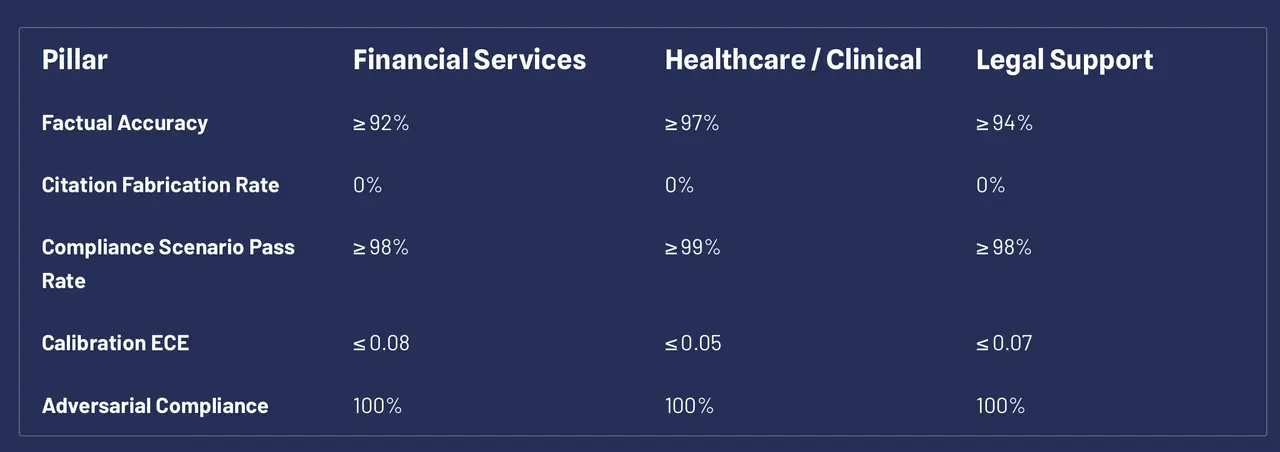
Once threshold gates are cleared, compute a composite score using domain-specific pillar weights. A financial services deployment might allocate 30% to regulatory alignment, 25% to factual accuracy, 20% to hallucination resistance, 15% to robustness, and 10% to auditability. A clinical deployment would increase the weight on hallucination resistance and auditability given FDA documentation requirements.
Benchmark Dataset Design Principles
The quality of your evaluation is entirely bounded by the quality of your benchmark dataset. A sophisticated scoring framework applied to a poorly constructed benchmark produces precise measurements of meaningless quantities.
Avoid Contamination at Every Stage
Benchmark contamination — the presence of evaluation queries or similar content in a model's pre-training data — is the most common and least controlled threat to evaluation validity. Mitigate it by constructing test cases from recent, domain-specific documents that post-date model training cutoffs; by generating novel hypothetical scenarios derivable from regulations but not verbatim present in them; and by using proprietary internal policy documents that cannot have appeared in public training corpora.
Difficulty Stratification
Evaluate across at least three difficulty tiers. Routine queries represent the bulk of real-world volume and must have near-perfect accuracy — failures here create systemic liability. Complex queries test genuine domain reasoning and reveal capability ceilings. Edge cases and adversarial examples reveal fragility under stress. An overall accuracy number that averages across these tiers can hide catastrophic failure on edge cases behind strong performance on routine queries.
Temporal Versioning
Your benchmark must be treated as a living artifact with versioning discipline analogous to software. When regulations change, update the golden answer set, mark deprecated cases as historical test sets (do not delete them), and document the change log explicitly. Benchmark version must be recorded alongside every evaluation result to support longitudinal comparison.
Construction warning: Do not build your benchmark primarily from publicly available regulatory FAQs or exam preparation materials — these are almost certainly present in LLM training data. Construct cases from primary regulatory texts, recent no-action letters, enforcement actions, and proprietary interpretive guidance that is unlikely to be in the training distribution.
Tooling and Automation Infrastructure
Manual evaluation at the scale required for regulated deployments is not sustainable. A robust evaluation infrastructure automates what can be automated, preserves human judgment where it cannot be replaced, and creates the audit trail that regulators expect.
Evaluation Pipeline Structure
A practical pipeline has five stages. Stage one runs automated scoring — factual probes, hallucination suites, and perturbation tests — against the full benchmark. These are fast and cheap to run and should be executed on every candidate model. Stage two applies LLM-as-judge evaluation for open-ended outputs that require semantic judgment: is this response compliant? does this reasoning support the conclusion? Stage three routes a smaller set of flagged edge cases to human domain experts for review. Stage four checks all hard thresholds and computes composite scores only if gate criteria are passed. Stage five generates a signed, version-stamped evaluation report as a compliance artifact.
LLM-as-Judge Considerations
For open-ended outputs that require semantic judgment, LLM-as-judge approaches can scale human-quality assessment. However, they introduce their own bias risks: the judge model may share failure modes with the evaluated model, especially if both are from the same provider. Use judges from different providers and validate judge calibration against a human-annotated calibration set before relying on it at scale.
Structured Red Teaming for Regulated Contexts
Red teaming in regulated workflows is distinct from general AI safety red teaming. The goal is not primarily to find jailbreaks — it is to systematically probe the specific failure modes that would create regulatory liability or real-world harm in your specific deployment context.
Domain-Specific Attack Surfaces
The attack surfaces that matter most depend on the workflow. Financial compliance tools face regulatory arbitrage probes — queries that attempt to identify loopholes or construct technically-compliant but substantively-evasive interpretations of rules. Clinical decision support faces diagnostic anchor attacks — presenting misleading symptom orderings that might bias a model toward a convenient but incorrect diagnosis. Contract analysis tools face adversarial clause detection — documents with provisions designed to be overlooked or misclassified by the model.
Social Engineering and Role Confusion
A class of red-team probe particularly important for customer-facing regulated applications tests whether the model can be manipulated through social engineering into providing harmful outputs. This includes authority spoofing (claiming to be a regulator or physician with special permissions), urgency manipulation (claiming emergency situations that justify bypassing normal constraints), and gradual boundary erosion (multi-turn conversations that incrementally shift the model's behavior).
Structuring the Red Team Exercise
Begin with a threat modeling phase: before any testing, document the specific adversarial scenarios relevant to your deployment, who the potential bad actors are, what they would want the model to do, and what harm would result. Compose the red team independently from the model selection and prompt engineering process, and include domain experts — compliance lawyers, clinical pharmacists, financial advisors — who understand the regulatory nuances that generic security testers would miss. Classify all findings by the regulatory risk they represent, not just technical novelty. And verify every remediation: fixes applied through prompt engineering, fine-tuning, or guardrails must be re-tested to confirm they hold without introducing regressions.
Applying the Framework to Vendor Selection
When evaluating commercial LLM providers, the framework applies with additional considerations around what evidence you can obtain from vendors and what commitments you can contractually establish.
What to Request from Vendors
- Model cards with training data descriptions and known limitation documentation
- Third-party safety and alignment evaluation reports, not just internal benchmarks
- Documented model versioning policy: when do models change, how are you notified, can you pin to a version?
- Data handling agreements confirming that inference data is not used for model training
- SLA commitments on output consistency across equivalent inputs
- Audit log access and retention commitments
- Incident response procedures for model behavior regressions
- Regulatory compliance documentation (SOC 2, HIPAA BAA, ISO 27001 as applicable)
The Reproducibility Problem
Vendor-hosted models are updated continuously, and providers rarely give advance warning of behavioral changes that don't affect stated performance benchmarks. Build your evaluation pipeline to run on a scheduled basis against any production model — not just at initial selection — to detect behavioral drift before it becomes a regulatory event. A model that passed your evaluation last quarter may not pass it today if the vendor has updated it.
"Model evaluation is not a one-time gate. It is a continuous monitoring function, no different in principle from transaction surveillance or adverse event reporting."
From Benchmark to Deployment: Governance Integration
A benchmark framework that produces a score but does not connect to governance processes adds analytical value without operational impact. The final piece of the framework is the bridge from evaluation results to deployment decisions and ongoing monitoring.
The Model Risk Management Connection
For financial institutions, the OCC's Model Risk Management guidance (SR 11-7) provides the regulatory framework within which LLM evaluation must operate. The five-pillar framework described here maps naturally onto SR 11-7's requirements for model development, validation, and ongoing monitoring. Evaluation results should be documented in the model inventory and reviewed by the model risk management function, not just the data science team.
Staged Deployment with Monitoring Gates
Even a model that passes all evaluation thresholds should not be deployed at full production scale immediately. A staged rollout allows real-world monitoring data to accumulate before full exposure.
Shadow mode: Run the model in parallel with existing processes, logging all outputs but not acting on them. Compare model outputs to actual decisions made by the parallel process to measure real-world divergence.
Limited pilot: Deploy to a small, low-risk segment of the workflow with heightened human review of all model outputs. Collect systematic feedback from domain experts reviewing the outputs.
Expanded rollout: Scale deployment with automated monitoring dashboards tracking key accuracy and compliance metrics. Define drift triggers that automatically suspend the model and escalate to human review if metrics deteriorate.
Full production: Complete deployment with scheduled re-evaluation against the full benchmark suite on a defined cadence — quarterly is typical for high-risk applications — plus event-triggered re-evaluation when regulatory changes or incidents occur.
Conclusion
The temptation in regulated industries is to evaluate LLMs the way the model providers evaluate them: general-purpose benchmarks, human preference ratings, and informal red-team exercises. These are better than nothing, but they are not good enough. The specific failure modes that matter in financial compliance, clinical care, legal analysis, and insurance are not measured by MMLU scores or GPT-4 win rates. They require purpose-built evaluation infrastructure, domain-expert involvement, and a governance mindset that treats model evaluation as a continuous organizational function rather than a one-time technical exercise.
The five-pillar framework described here — factual accuracy, hallucination risk, regulatory alignment, auditability, and robustness — covers the evaluation surface that regulated workflows actually require. It is not a fixed recipe; different domains will weight pillars differently, thresholds will vary by risk appetite, and specific benchmark content must be constructed for each deployment context. But the structure provides a defensible, comprehensive starting point that can be adapted, documented, and presented to a regulator or auditor with confidence.
Organizations that invest in this evaluation infrastructure now will be positioned to deploy AI capabilities that their competitors cannot — not because they found a braver risk appetite, but because they built the evidence base to justify deployment that others lack. In regulated industries, rigorous evaluation is not the obstacle to AI adoption. It is the path to it.\